Case Study
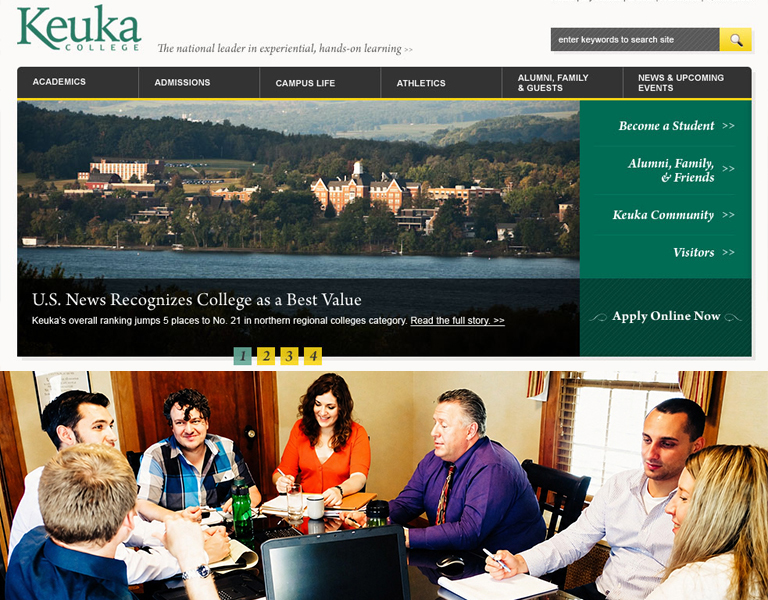
Keuka College
Multi-audience content strategy and editorial voice design for a full university website redesign — 50+ stakeholder interviews, four distinct audience voices, one coherent editorial system.
[ Multi-Audience Content Strategy ] [ Editorial Voice Design ] [ Stakeholder Research ] [ Bilingual EN/ES ]
Role
Content Strategist & Information Architect
Client
Keuka College, New York · ShiftFWD
Overview
Full university website content strategy — 50+ stakeholder interviews, multi-audience editorial architecture, and 4 customized banner campaigns targeting distinct audiences with distinct editorial voices.
Client
Keuka College, NY
Agency: ShiftFWD
Skills
Content Strategy
Multi-Audience Architecture
Editorial Voice Design
Stakeholder Interviewing
Information Architecture
Bilingual EN/ES
Link
→ shiftfwd.comThe challenge
Keuka College — a New York university known for its hands-on, experiential learning model — needed to redefine its brand voice and communication strategy across all channels: website, print marketing, email campaigns, and institutional materials.
The challenge was not primarily digital. It was editorial: how to build a coherent voice that could serve four fundamentally different audience groups across every touchpoint. The institution, individual departments, current students, and prospective students each had distinct information needs, priorities, and communication expectations. And within those groups, sub-audiences — parents, student athletes, faculty — required their own editorial register and motivational logic.
Existing communication was fragmented, inconsistent in voice, and organized around internal departmental logic rather than audience needs. No single editorial framework governed how the college spoke to any of its audiences — online or offline.
The process
My role focused on the research, content strategy, and editorial voice design phases — working in close collaboration with UX designer Naomi Niles (ShiftFWD). I conducted 50+ in-person interviews with faculty, department heads, deans, and senior administrators — in English and Spanish — to surface content priorities, institutional voice, and inter-departmental communication gaps.
I also organized and facilitated working sessions with the college’s executive board to align content strategy with institutional objectives. From that research I developed the site’s editorial architecture: a multi-audience content system that served each group’s distinct needs without sacrificing overall coherence.
This included defining the site’s editorial voice — tone, terminology, section naming conventions, and header frameworks consistent across all departments. A key deliverable was a set of 4 campaign banners — each targeting a different audience with a distinct editorial voice and emotional logic.
Brief → Final Copy — 4-voice editorial comparison
Voice 1 — Parents
Audience: parents. Concept: success and happiness at graduation after sustained effort. Connect to college environment. Parents see this and decide their child will be better prepared for the future and will exceed their own professional limits.
They Graduate, They Win a Life!
Voice 2 — Students
Audience: current students. Concept: shared community experience that changes life positively through collective effort. Students feel they will have experiences that make them better people, and will want to convince their parents this is the right choice.
They Learn Together, They Lead Life!
Voice 3 — Student Athletes & Parents
Audience: parents and student athletes. Concept: enthusiasm in a competitive sports context, excellence, being winners in life. For many US students, sports is a key admission and funding strategy — especially at private institutions.
Win in Class. Win in Life!
Voice 4 — Prospective Faculty
Audience: prospective faculty. Concept: excitement about working in a place where teaching creates a close relationship with students, with the goal of stimulating their capabilities. Concepts of experience, science, and close mentorship are key.
Ignite Minds! Shape A Better Future!
Final Cards — 4 banners

Parents

Students

Student Athletes & Parents

Prospective Faculty
Results & impact
Investor engagement — parents as primary decision-makers in college selection — improved by 40% following the implementation of the new editorial voice and communication framework.
Staff and current students rated the redesigned website significantly higher in satisfaction and ease-of-use. The content architecture successfully balanced institutional needs with user-centered navigation — resolving a challenge that had previously prevented effective redesign attempts.
The 4-voice editorial system demonstrated that a single institution can maintain a coherent brand identity while speaking in genuinely different registers to genuinely different audiences — without contradiction or dilution.
The project was recognized by Crazy Egg, Unbounce, and Kissmetrics as a reference case in content strategy and information architecture.
Skills demonstrated
This project demonstrates multi-audience content strategy applied at institutional scale — from primary qualitative research to editorial voice design and brand communication. Key skills in action:
- Multi-audience content architecture — 4 distinct audience groups served simultaneously
- Stakeholder interviewing — 50+ in-person interviews in English and Spanish
- Editorial voice design — 4 distinct registers for parents, students, athletes, and faculty
- Brand voice development — tone, terminology, and messaging frameworks
- Information architecture — content hierarchy and navigation structure
- Institutional communication strategy — applied across web, print, and email