Case Study
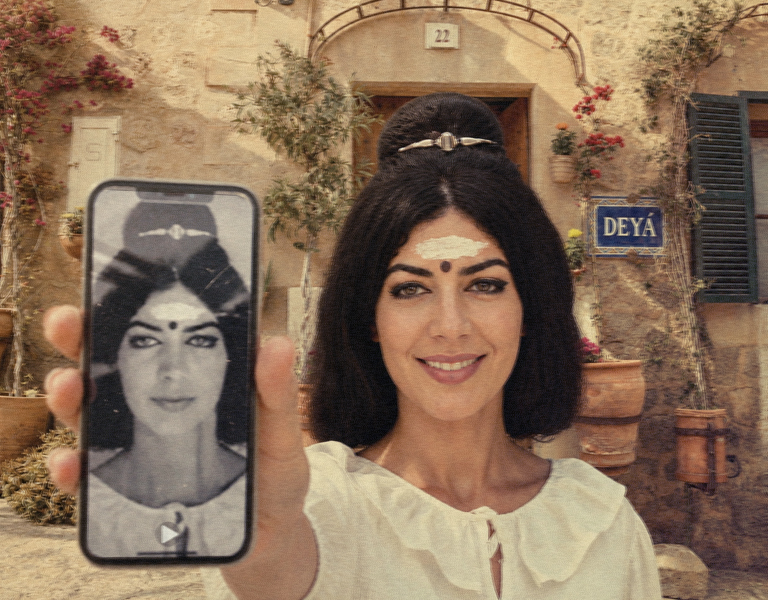
Deya Before The Myth
Scripting a 30-second AI-narrated micro-documentary from raw historical data — with strict timing constraints, a precisely calibrated editorial voice, and a visual rhythm built on snap, snap, snap.
[ AI-Assisted Production ] [ Script Editing ] [ Timing & Rhythm ] [ Narrative Voice ] [ Multi-format Adaptation ] [ Storytelling ]
Role
Original Concept · Scriptwriter · Editor · Director
Format
AI-narrated micro-documentary · 8 scenes · 30 sec.
Overview
A bilingual micro-documentary about the countercultural history of Deya, Mallorca — scripted from raw historical data with strict timing constraints and a highly specific editorial voice.
Project
Deya Before The Myth
Platform
Instagram · micro-documentary series
Tools
CutCap (AI narration)
Generative Image
Video editing
Montage & direction
Skills
Script Editing
Narrative Voice Design
Timing & Rhythm
Historical Research
AI-Assisted Production
Multi-format Adaptation
The challenge
The raw material was a set of factual historical briefs — bullet points listing dates, locations, figures, and cultural events related to the countercultural history of Deya, Mallorca. Accurate, verifiable, and completely inert.
The editorial challenge was triple: transform dry historical data into a narrative that felt alive and urgent; calibrate every line to a strict 18-second timing constraint per scene so the AI narration could synchronize with the visual sequence; and find a voice that was culturally specific — not academic, not journalistic, not generic — but tonally aligned with the countercultural era being described.
The guiding principle for the entire script was a single internal directive: snap, snap, snap. Short. Percussive. Precise.
The process
Each of the 8 scenes began as a structured data brief — a list of facts with no narrative connective tissue. My first task was to read those facts not as information but as material: identifying which details carried emotional weight, which created contrast, and which could generate forward momentum when placed in sequence.
Text length was not a stylistic choice — it was an engineering constraint. Each narrated segment had to land within approximately 18 seconds. That meant calculating word count, syllable density, and pause rhythm before writing a single sentence. Every word either earned its place or was cut.
The voice design was equally specific. The cultural world of Deya in the 1950s and 60s — beatniks, experimental musicians, visual artists, Robert Graves — had an aesthetic register: minimal, elliptical, anti-rhetorical. The script had to carry that tone without becoming pastiche. Short declarative sentences. No adjective without function. No transition that explained itself.
Once the script was locked, I directed the AI narration through CutCap, adjusting pacing and delivery to match the visual montage. The final edit synchronized text, voice, image, and rhythm into a single continuous sequence.
Script Sample — Scene 8 (final scene)
Deya mutates. Less literary. More sonic. More psychedelic. Still strange. Still alive. And this— was already happening.
Mid-1950s footage. Deya. Over a decade before it goes global. Before the East gets imported. India. Morocco. Before the trips. Before the myth.
Before & After — Script cards · Brief vs. Final
Scene Brief — Raw factual data
· Topic: Pre-Hippie Trail context (before 1960s).
· Common narrative gap: Ibiza as an early precursor.
· Key period: 1930s.
· Location: Ibiza.
· Population profile: European intellectuals, artists, social outsiders.
· Environmental characteristics: Early international community.
· Historical relation: Predates hippie movement routes to Goa and Kathmandu in the 1960s.

Final Script — Edited narrative
Scene Brief — Raw factual data
· Timeframe: Mid-1960s.
· Geographic context: Balearic Islands, specifically Ibiza.
· Event: Arrival of first American hippies.
· Cultural shift: Transition of Ibiza into an active countercultural center.
· Characterization: Emergence as an international hub of counterculture.
· Temporal positioning: Develops prior to major counterculture centers in San Francisco and London.

Final Script — Edited narrative
Scene Brief — Raw factual data
· Timeframe: Early 1950s.
· Location: Ibiza.
· Event: Formation of small beatnik communities.
· Cultural classification: Early beatnik subculture presence.
· Environmental characteristics: Low visibility.

Final Script — Edited narrative
Scene Brief — Raw factual data
· Geographic relation: Proximity to Ibiza.
· Location: Mallorca. Specific site: Deià.
· Environmental characteristics: Coastal mountain village.
· Cultural development: Early formation of an emerging creative/intellectual community.
· Status: Initial stage of cultural consolidation (pre-recognition).

Final Script — Edited narrative
Scene Brief — Raw factual data
· Timeframe: From 1946 to 1985.
· Event: Arrival of Robert Graves with his family in 1946.
· Residence: Ca n’Alluny. Permanent residence established.
· Duration: Lived there until his death in 1985.
· Cultural activity: Attraction point for visiting creatives.
· Notable visitors: Gabriel García Márquez. Ava Gardner.

Final Script — Edited narrative
Scene Brief — Raw factual data
· Timeframe: Mid-1950s.
· Cultural shift: Arrival of a new generation of visual artists.
· Integration: Connection to the cultural circle around Robert Graves.
· Key figure: Artist Mati Klarwein.

Final Script — Edited narrative
Scene Brief — Raw factual data
· Timeframe: Late 1960s (approx.).
· Event: Arrival of Robert Wyatt (Soft Machine) and George Neidorf in Mallorca.
· Cultural alignment: Wyatt already aligned with experimental, avant-garde, and psychedelic music culture. Settlement near the circle of Robert Graves.
· Additional arrivals: Daevid Allen. Arrives connected to Robert Wyatt. Establishes long-term residence. 16 years. Partner: Gilli Smyth.
· Kevin Ayers. Arrives via connection with Robert Wyatt.

Final Script — Edited narrative
Scene Brief — Raw factual data
· Timeframe: Mid-1950s (documented footage).
· Cultural transformation: Gradual shift from literature-centered community toward music and sound-based practices. Increasing presence of experimental and psychedelic influences. Cultural activity predates international counterculture expansion by more than a decade.
· Contextual relation: Developments occur before Western counterculture engagement with Eastern destinations.
· Pre-myth phase: Activity occurs prior to organized trips, formation of the Hippie Trail narrative, and popularization of associated cultural mythology.

Final Script — Edited narrative
Results & impact
The final piece runs 30 seconds across 8 scenes — each one a self-contained editorial unit that functions independently while building a cumulative narrative arc. The result is a micro-documentary that feels simultaneously historical and contemporary: dense with verified fact, but driven by rhythm and voice rather than explanation.
The project demonstrates what AI-assisted editorial production looks like when the human editorial layer is doing its full job: the AI narrates, but the decisions about what to say, how long to say it, in what order, and with what tone are entirely editorial — made before the first word reaches the narration engine.
It also demonstrates the specific skill of adapting content to extreme format constraints — where word count, syllable count, and timing are not secondary considerations but the primary editorial framework.
Skills demonstrated
This project demonstrates the ability to transform raw factual data into a precisely timed, tonally specific narrative under strict multi-dimensional constraints. Key skills in action:
- Script editing — narrative construction from bullet-point historical data
- Timing and rhythm — word count and syllable density calibrated to 18-second constraints
- Editorial voice design — culturally specific register sustained across 8 scenes
- AI-assisted production — directing CutCap narration with editorial precision
- Multi-format adaptation — content engineered for video, voice, and visual simultaneously
- Generative Art integration — visual and narrative production combined