Case Study
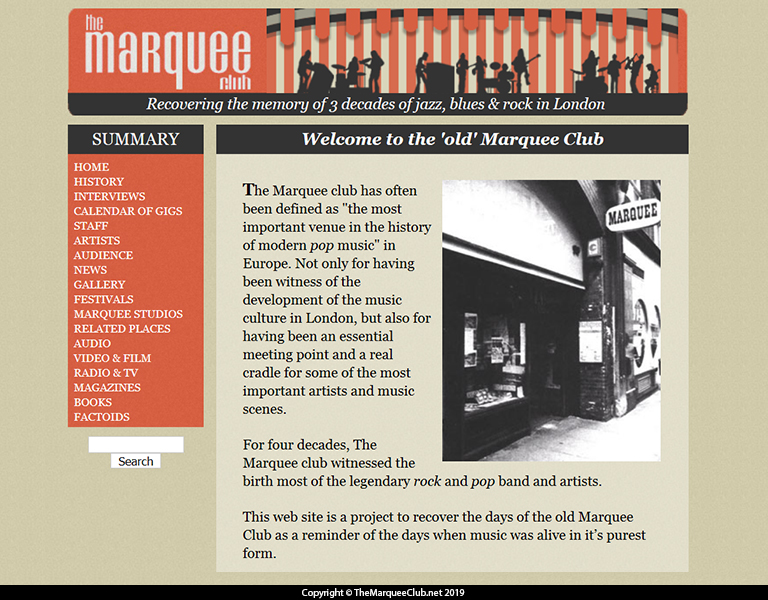
The Marquee Club Archive
Reconstructing four decades of rock history through original research, first-hand interviews, and bilingual editorial production — from raw factual data to published articles with distinct editorial voices in English and Spanish.
[ Bilingual Editorial Production ] [ Interview & Transcription ] [ Research-to-Content ] [ Tone & Voice Design ]
Role
Founder & Editorial Director
Period
2005 – 2023 · Remote
Overview
18-year independent editorial project reconstructing four decades of The Marquee Club history — from raw factual briefs and first-hand interviews to bilingual published articles in English and Spanish.
Project
TheMarqueeClub.net
Format
100+ bilingual articles · EN/ES · 18 years
Skills
Historical Research
Interview & Transcription
Bilingual Editing EN/ES
Tone & Voice Design
Narrative Writing
Content Architecture
The challenge
In 2005, The Marquee Club — London’s most iconic rock, jazz, blues venue, launching ground for The Rolling Stones, David Bowie, Jimi Hendrix, Led Zeppelin and YES — had almost no documented history available online or in print. No books. No documentary films. Decades of performance records, artist appearances, and first-hand memories were scattered, unverified, or lost entirely.
The editorial challenge was to reconstruct that history from primary sources — contacting surviving artists, conducting original voice interviews, and transforming raw material into readable, accurate, and engaging editorial content.
A second challenge emerged as the project grew: producing the same content in two languages for two distinct audiences — English-speaking readers familiar with formal music journalism, and Spanish-speaking readers who responded better to a warmer, less academic register.
The process
Each article followed a consistent 4-stage editorial pipeline: factual research produced a structured data brief. That brief went through two distinct editorial stages — English narrative construction and independent Spanish adaptation — before publication.
The first stage was narrative construction in English: transforming bullet-point facts into coherent, readable prose with a clear voice, accurate attribution, and editorial flow. The second stage was bilingual adaptation — not translation. The Spanish version was written independently, with a deliberately more informal, conversational register. Where the English maintained the tone of music journalism, the Spanish version spoke more directly to the reader and foregrounded personality over chronology.
Interviews were conducted by voice, transcribed, and edited — preserving the interviewee’s voice while ensuring clarity, factual accuracy, and structural coherence. Artists interviewed included Peter Banks (Yes), Chris Barber, Glenn Cornick (Jethro Tull), David O’List (The Nice), Diz Minnitt (Marillion), and Judy Dyble (Fairport Convention).
Example 1 — Peter Banks / Yes · 4-stage editorial transformation
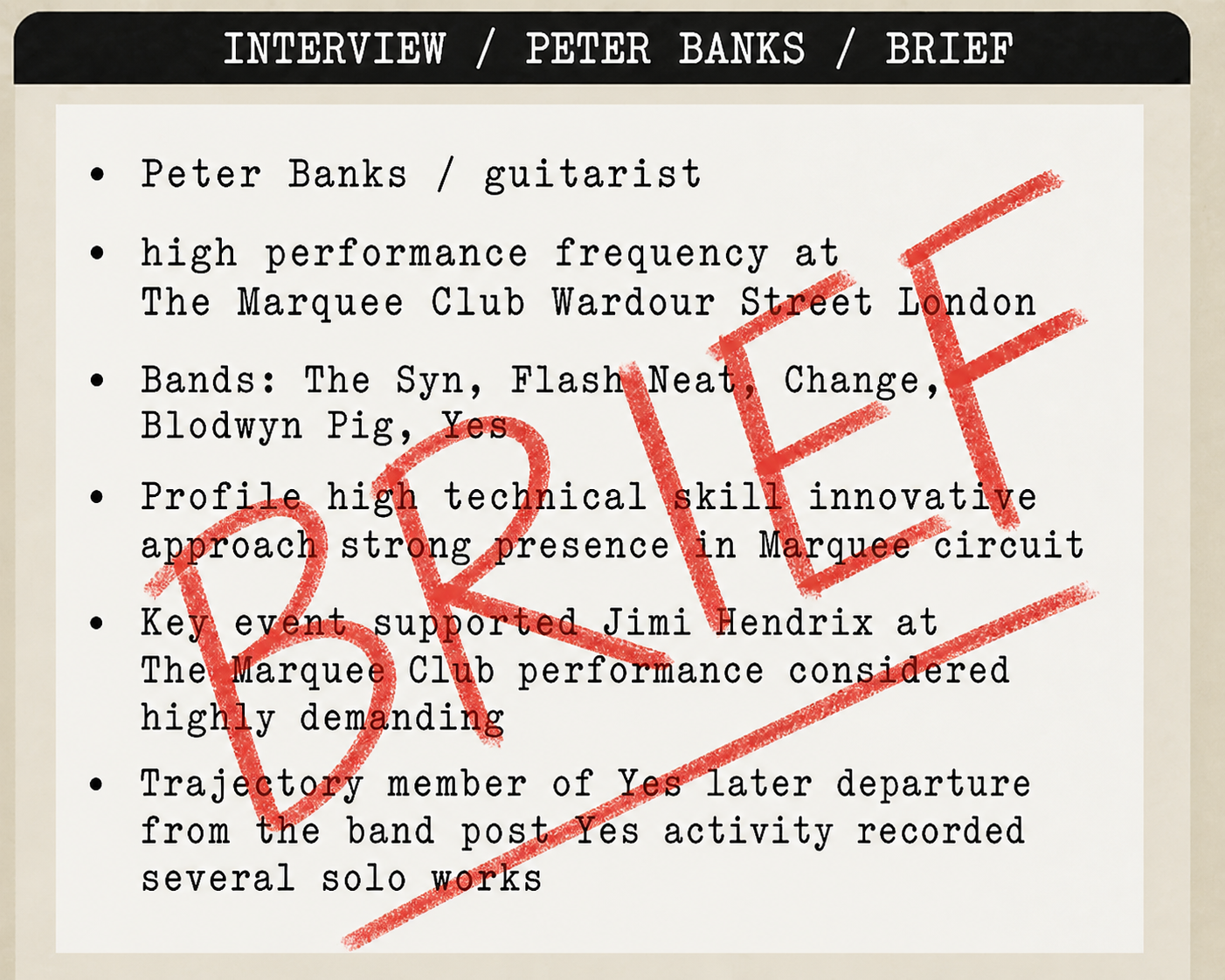
Stage 1 — Raw factual brief
Peter Banks / guitarist · high performance frequency at The Marquee Club · Bands: The Syn, Flash, Neat Change, Blodwyn Pig, Yes · supported Jimi Hendrix at The Marquee Club · post Yes activity recorded several solo works
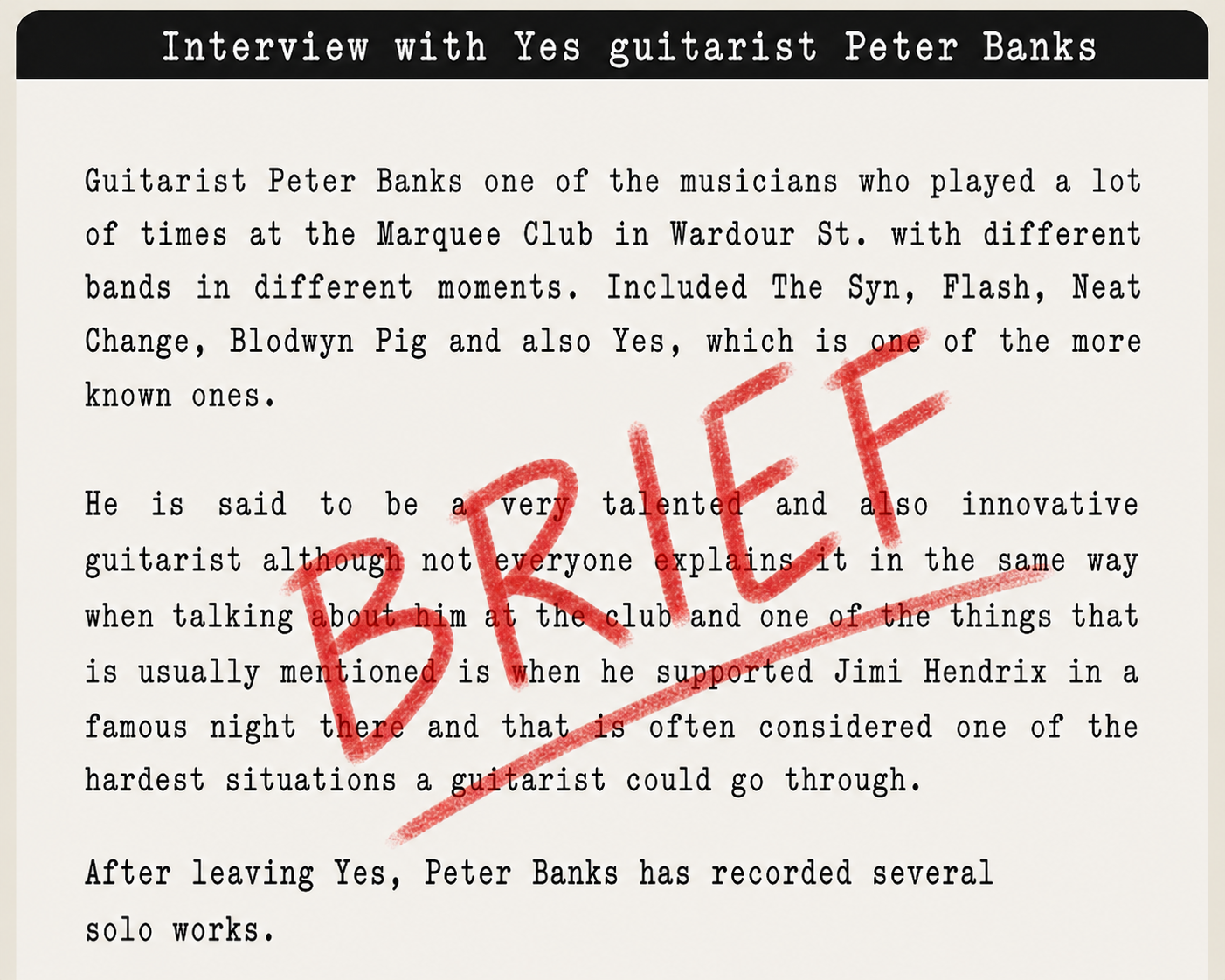
Stage 2 — Unedited draft
Guitarist Peter Banks one of the musicians who played a lot of times at the Marquee Club in Wardour St. with different bands in different moments. Included The Syn, Flash, Neat Change, Blodwyn Pig and also Yes, which is one of the more known ones.
He is said to be a very talented and also innovative guitarist although not everyone explains it in the same way when talking about him at the club and one of the things that is usually mentioned is when he supported Jimi Hendrix in a famous night there and that is often considered one of the hardest situations a guitarist could go through.
After leaving Yes, Peter Banks has recorded several solo works.
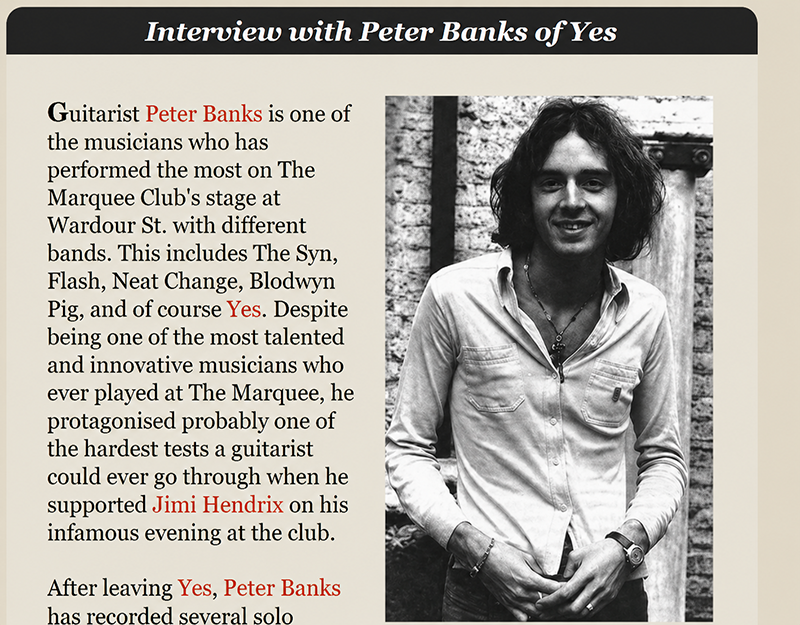
Stage 3 — Final edited English
Guitarist Peter Banks is one of the musicians who has performed the most on The Marquee Club’s stage at Wardour St. — with The Syn, Flash, Neat Change, Blodwyn Pig, and of course Yes. Despite being one of the most talented and innovative musicians who ever played at The Marquee, he protagonised probably one of the hardest tests a guitarist could ever go through when he supported Jimi Hendrix on his infamous evening at the club.
Stage 4 — Final adapted Spanish
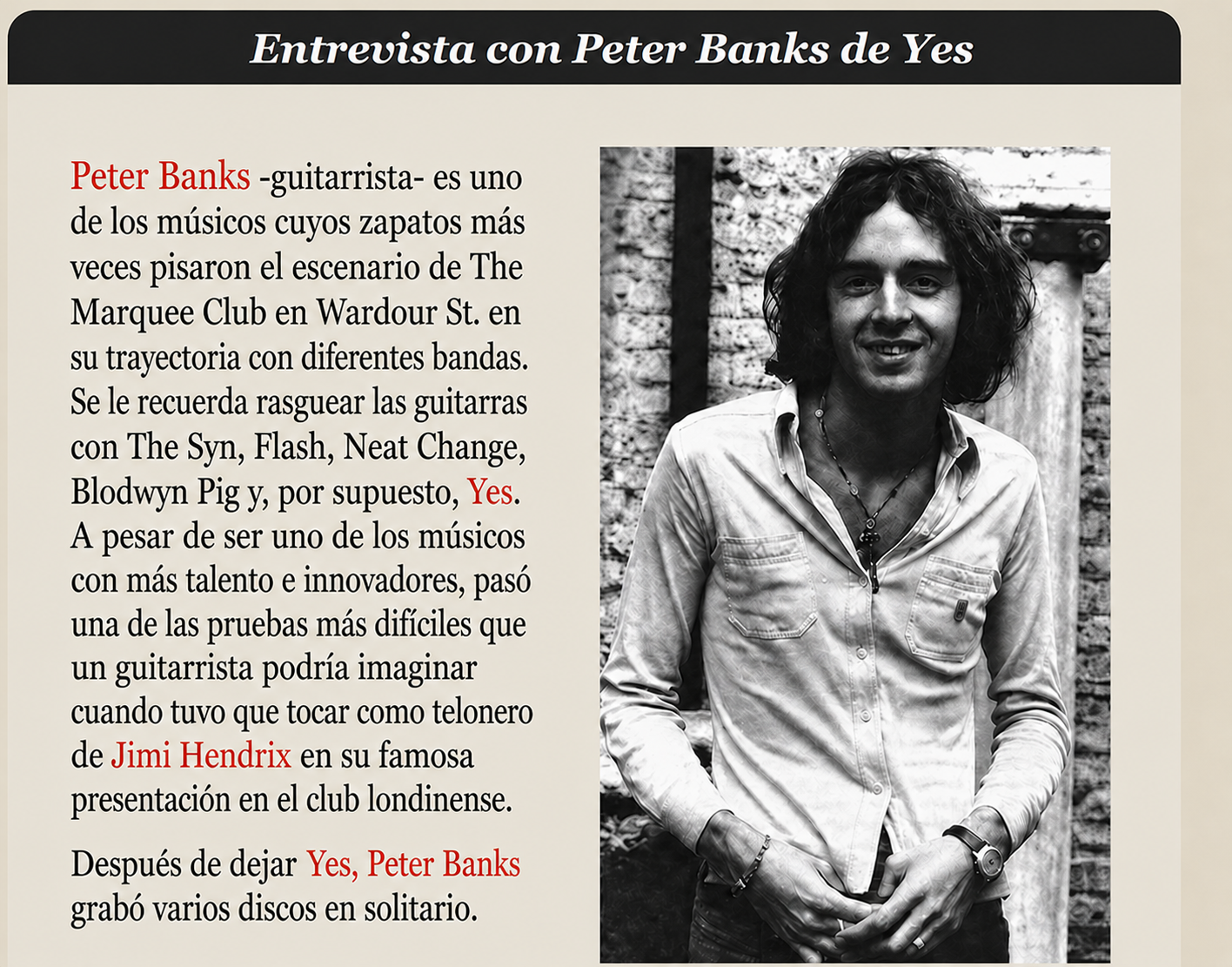
Peter Banks -guitarrista- es uno de los músicos cuyos zapatos más veces pisaron el escenario de The Marquee Club en Wardour St. en su trayectoria con diferentes bandas. Se le recuerda rasguear las guitarras con The Syn, Flash, Neat Change, Blodwyn Pig y, por supuesto, Yes. A pesar de ser uno de los músicos con más talento e innovadores, pasó una de las pruebas más difíciles que un guitarrista podría imaginar cuando tuvo que tocar como telonero de Jimi Hendrix en su famosa presentación en el club londinense.
Editorial Cards — Peter Banks / Yes · 4-stage sequence
Stage 1 — Raw brief
Stage 2 — Unedited draft
Stage 3 — Final edited EN
Stage 4 — Final adapted ES
Example 2 — Ken Scott · EN + ES editorial comparison
Final edited English
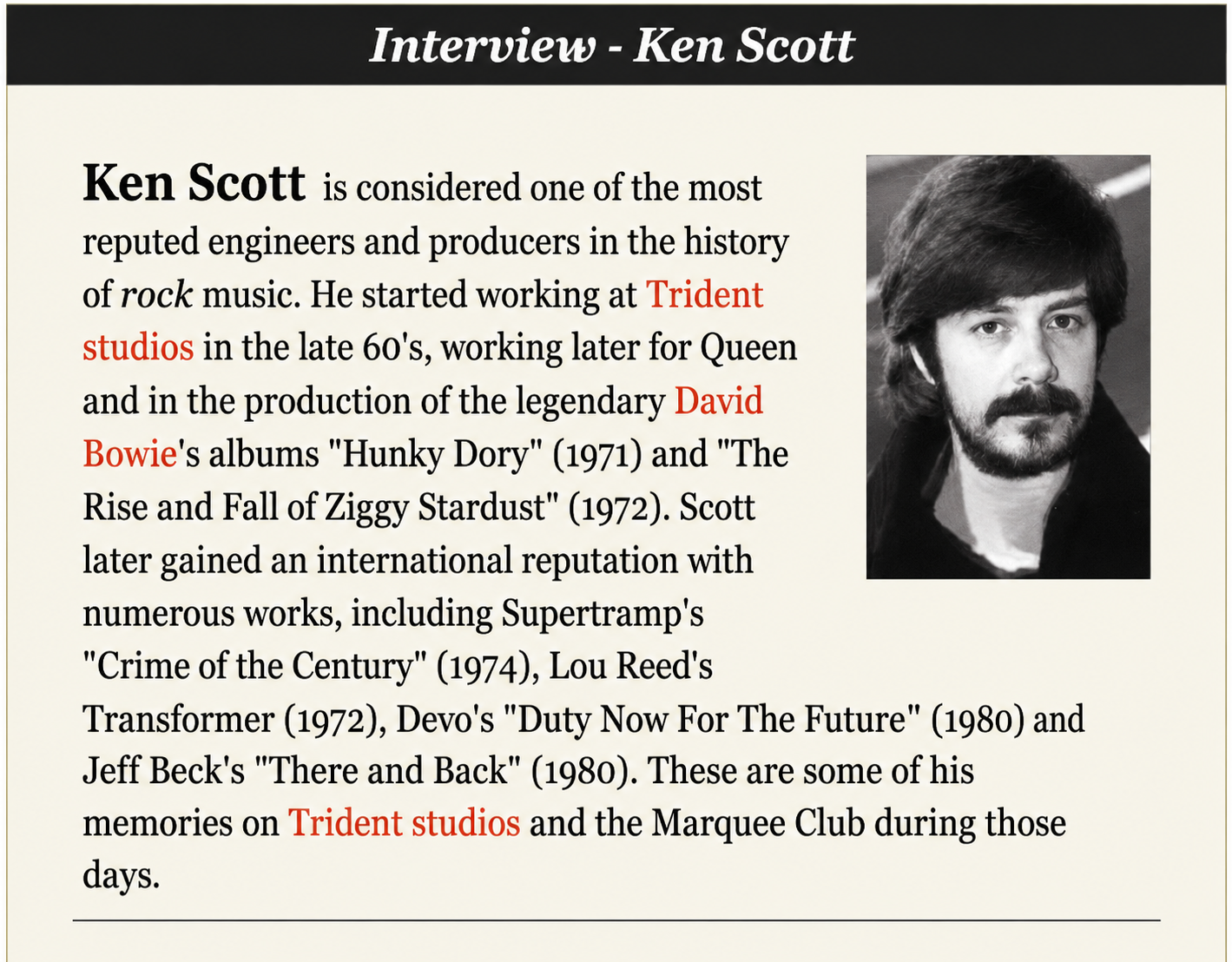
Ken Scott is considered one of the most reputed engineers and producers in the history of rock music. He started working at Trident Studios in the late 60s, working later for Queen and in the production of the legendary David Bowie’s albums “Hunky Dory” (1971) and “The Rise and Fall of Ziggy Stardust” (1972). Scott later gained an international reputation with numerous works, including Supertramp’s “Crime of the Century” (1974), Lou Reed’s Transformer (1972), Devo’s “Duty Now For The Future” (1980) and Jeff Beck’s “There and Back” (1980). These are some of his memories on Trident Studios and the Marquee Club during those days.
Final adapted Spanish
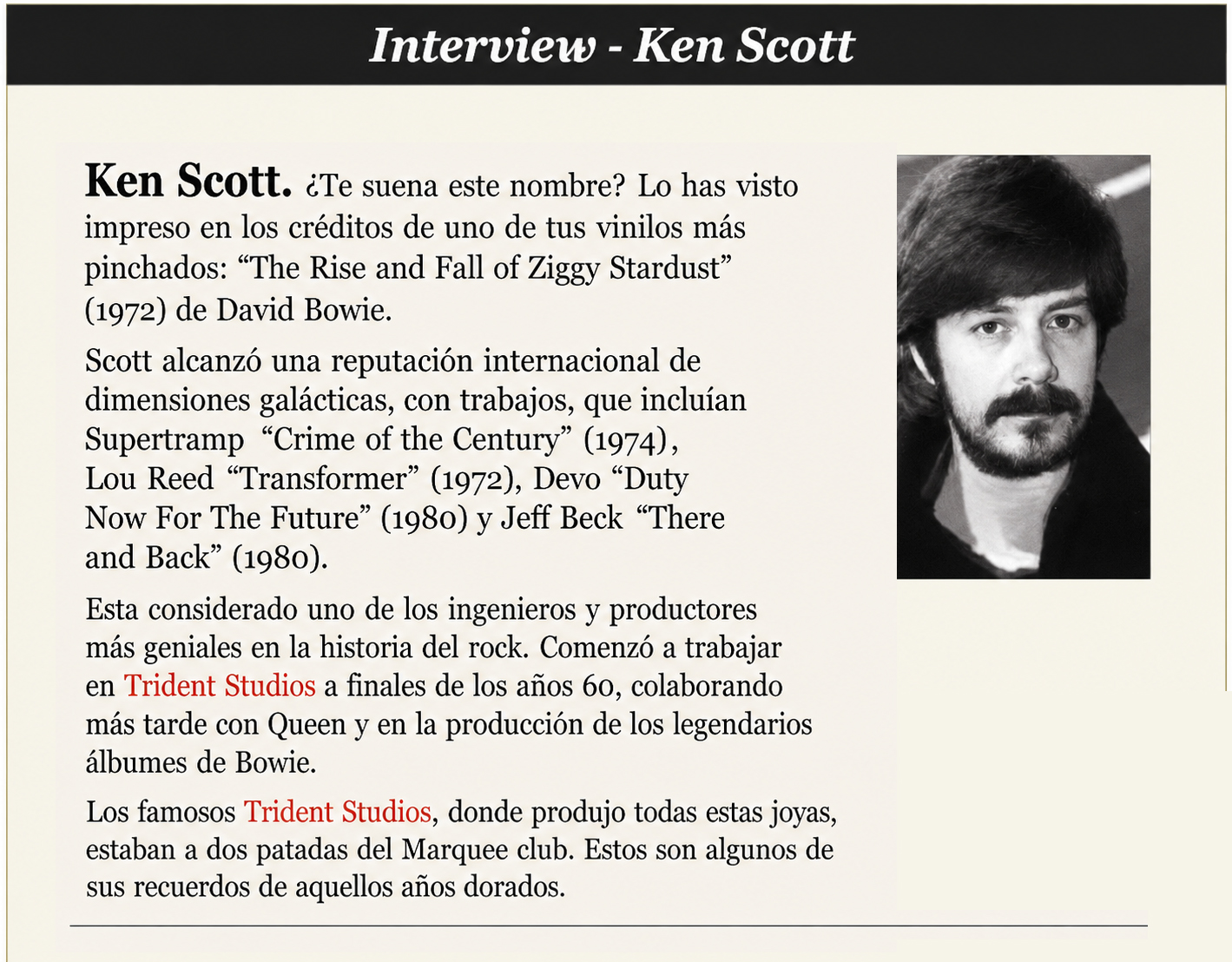
Ken Scott. ¿Te suena este nombre? Lo has visto impreso en los créditos de uno de tus vinilos más pinchados: “The Rise and Fall of Ziggy Stardust” (1972) de David Bowie.
Scott alcanzó una reputación internacional de dimensiones galácticas, con trabajos que incluían Supertramp “Crime of the Century” (1974), Lou Reed “Transformer” (1972), Devo “Duty Now For The Future” (1980) y Jeff Beck “There and Back” (1980).
Está considerado uno de los ingenieros y productores más geniales en la historia del rock. Comenzó a trabajar en Trident Studios a finales de los años 60, colaborando más tarde con Queen y en la producción de los legendarios álbumes de Bowie.
Los famosos Trident Studios, donde produjo todas estas joyas, estaban a dos patadas del Marquee Club. Estos son algunos de sus recuerdos de aquellos años dorados.
Example 2 — Ken Scott · EN + ES versions
Final edited EN
Final adapted ES
Results & impact
Over 18 years, the archive grew to 100+ bilingual editorial articles — artist profiles, venue history, performance records, and first-hand interviews — becoming the primary reference source for The Marquee Club history online.
The archive directly contributed to three subsequent productions: The Marquee Club: The Birthplace of Rock (2006 documentary), YES Classic Arts (2013 documentary), and Marquee: The Story of the World’s Greatest Music Venue (2024 book).
The platform reached 5,000 unique monthly visits at peak. The bilingual editorial decision — distinct voices for EN and ES, not translation — proved editorially significant. The Spanish version developed its own readership and identity, demonstrating that effective bilingual content requires independent editorial judgment in each language.
Skills demonstrated
This project demonstrates the full editorial pipeline from primary research to bilingual publication — applied at scale over 18 years. Key skills in action:
- Historical research — primary source reconstruction from scratch
- Interview production — voice interviews, transcription, and editorial adaptation
- Bilingual editing EN/ES — distinct editorial voice per language and audience
- Narrative writing — transforming raw factual data into readable, engaging content
- Long-form content management — 100+ articles sustained over 18 years
- Editorial impact — archive cited by 3 major documentary and book productions